






| Overview |
|
The pentagonal tiling was taken from the list of 14 known tilings of congruent convex pentagons. Two criteria had to be satisfied:
This tesselation was discovered by Marjorie Rice, who deserves equal credit in the creation of Pex. |
 Pex is a two-player abstract board game played on a board with pentagonal tiling that was invented by David Bush, an avid
 | Objective |
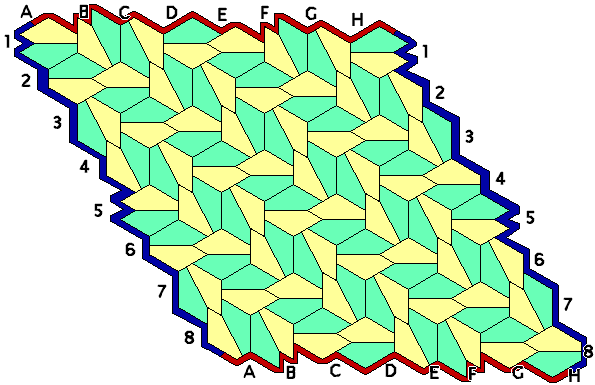
| The objective of Pex is to create a connected chain of a player's pieces linking the opposite edges of the board marked by the player's color. |
| Board |
|
Pex is played on a special board with pentagonal tiling. Pairs of opposite board edges are marked with two colors, usually Red and Blue.
|
| Play |
|
The game begins with an empty board. Each player has an allocated color, usually Red and Blue. Players take turns placing a stone of their color on any empty cell of the board. Since the first player has a distinct advantage, the pie rule is generally used for making the game fair. This rule allows the second player to switch colors as his first move. |
| End of Game |
|
The game ends when one of the players forms a connected chain of his stones linking two opposite board edges marked with his color. No draws are possible in Pex. |
| External Links |
