






| Overview |
 Reversi (more recently also known as Othello) is a two-player board game that was invented around 1880 by two Englishmen, Lewis Waterman and John W. Mollett. Reversi (more recently also known as Othello) is a two-player board game that was invented around 1880 by two Englishmen, Lewis Waterman and John W. Mollett.
|
| Board |
|
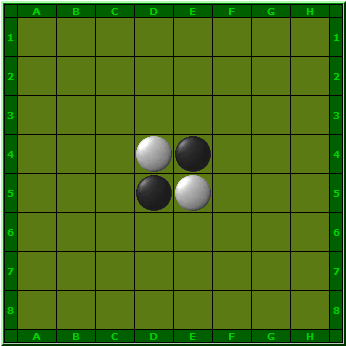
Reversi is played on an 8x8 board using special two-colored discs: one side of a disc is colored black and the other side is colored white. There are two players: White and Black. The initial position of the discs is shown in the following picture:
|
| Objective |
|
The goal of Reversi is to occupy more board cells with your own discs than your opponent when there are no more legal moves available, usually a result of the board being completely filled with discs. If the game ends with the same number of black and white discs placed on the board then the game ends in a draw. |
| Play | ||||||||
|
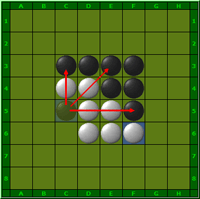
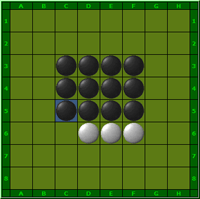
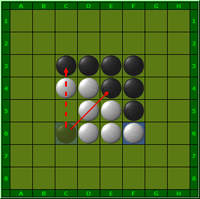
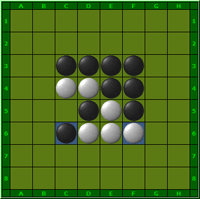
Players move alternately, starting with the player controlling the black discs. Each move consists of placing a single disc of a player's color to any empty cell of the board that results in flipping at least one disc. After placing the disc, a player flips all discs of the opponent's color lying on a straight horizontal, vertical or diagonal line between the newly placed disc and other discs of the player's color already placed on the board. Important notice: the opponent's discs are flipped if and only if there are no gaps (empty cells) between the newly placed disc and other player's discs. Below are several examples
If one player cannot make a valid move then the turn is passed to his opponent. When both players have no legal moves, the game ends. This occurs in the following situations:
When the game ends the player with the most discs on the board wins. |
||||||||
| External Links |
|
