






| Overview |
 Chess is a popular two-player abstract strategy board game which is of Indian and Persian descent. Chess is a popular two-player abstract strategy board game which is of Indian and Persian descent.
|
| Objective |
| The objective of Chess is to attack the opponent's King in such a way that the opponent cannot escape from the attack and cannot block it on his next turn. |
| Pieces | ||||||||||||||
|
At the beginning of the game the first player has 16 light pieces and the second player has 16 dark pieces:
|
 - one King
 - one King
 - one Queen
 - one Queen
 - two rooks
 - two rooks
 - two bishops
 - two bishops
 - two knights
 - two knights
 - eight pawns
 - eight pawns
| Board |
|
Chess is played on an 8x8 square board. The initial position of the pieces is shown in the following picture:
|
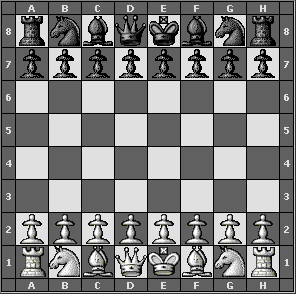
| Play | |
|
Players move alternately, starting with the player controlling the white pieces. No piece can be moved to a square occupied by another piece of the same color. If a piece moves to a square occupied by an enemy piece the latter is considered to be captured and is removed from the board. Capturing is not mandatory, i.e. if one of the player's pieces can capture an enemy piece it's not required to do so. If a piece A can capture an enemy piece B it's said that A attacks B or that B is under attack. The King is said to be "in check" if it is under attack by an enemy piece (even if the attacking piece cannot move for some reason). A player may never leave his king "in check" at the end of his move. The "in check" situation can be eliminated in one of the following ways:
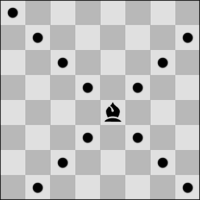
All possible moves for each type of piece are explained below. The Bishop can move any number of empty squares in any diagonal direction. The bishop cannot jump over other pieces.
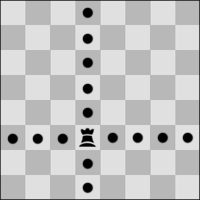
The Rook can move any number of empty squares horizontally or vertically. The rook cannot jump over other pieces. The rook is also moved when castling.
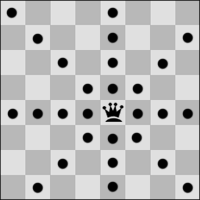
The Queen can move any number of empty squares diagonally, horizontally, or vertically. The queen cannot jump over other pieces.
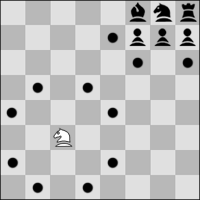
The Knight can move to the nearest square that is not on the same row, column or diagonal. In other words the knight moves two squares horizontally or vertically and then one square perpendicular to that. The Knight is the only piece that can jump over other pieces.
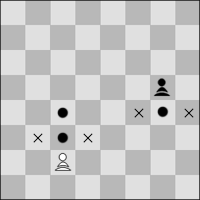
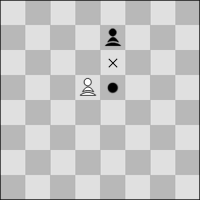
The Pawn can make several kind of moves and it captures enemy pieces in a different way from the other pieces:
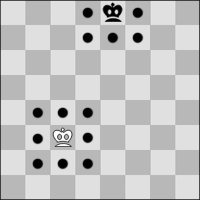
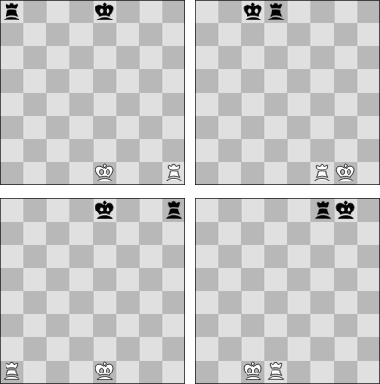
The King can make two kinds of move:
|
| End of Game |
|
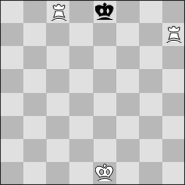
If a player puts an enemy king in check and the opponent cannot eliminate it on his next move, then the game ends and the player wins. Such a position is called checkmate. In the following picture the black king is in check (under attack of the white rook) and there is no way for black to escape from this situation:
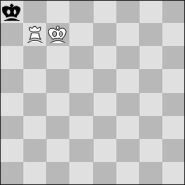
The game ends in a draw if a player's king is not in check and he has no legal moves on his turn. I.e. the player has no other pieces (or all of his pieces cannot move) and he cannot move his king without putting him in check. Such a situation is called a stalemate. In the following picture the black king is not in check but he cannot move since each of the two unoccupied adjacent squares are under attack by the white rook:
The game ends in a draw if there is no possibility for either player to checkmate the opponent. For example one player has a king and a knight and another only a king. Any player can claim a draw if one of the following conditions exists:
|
| External Links |
|
